
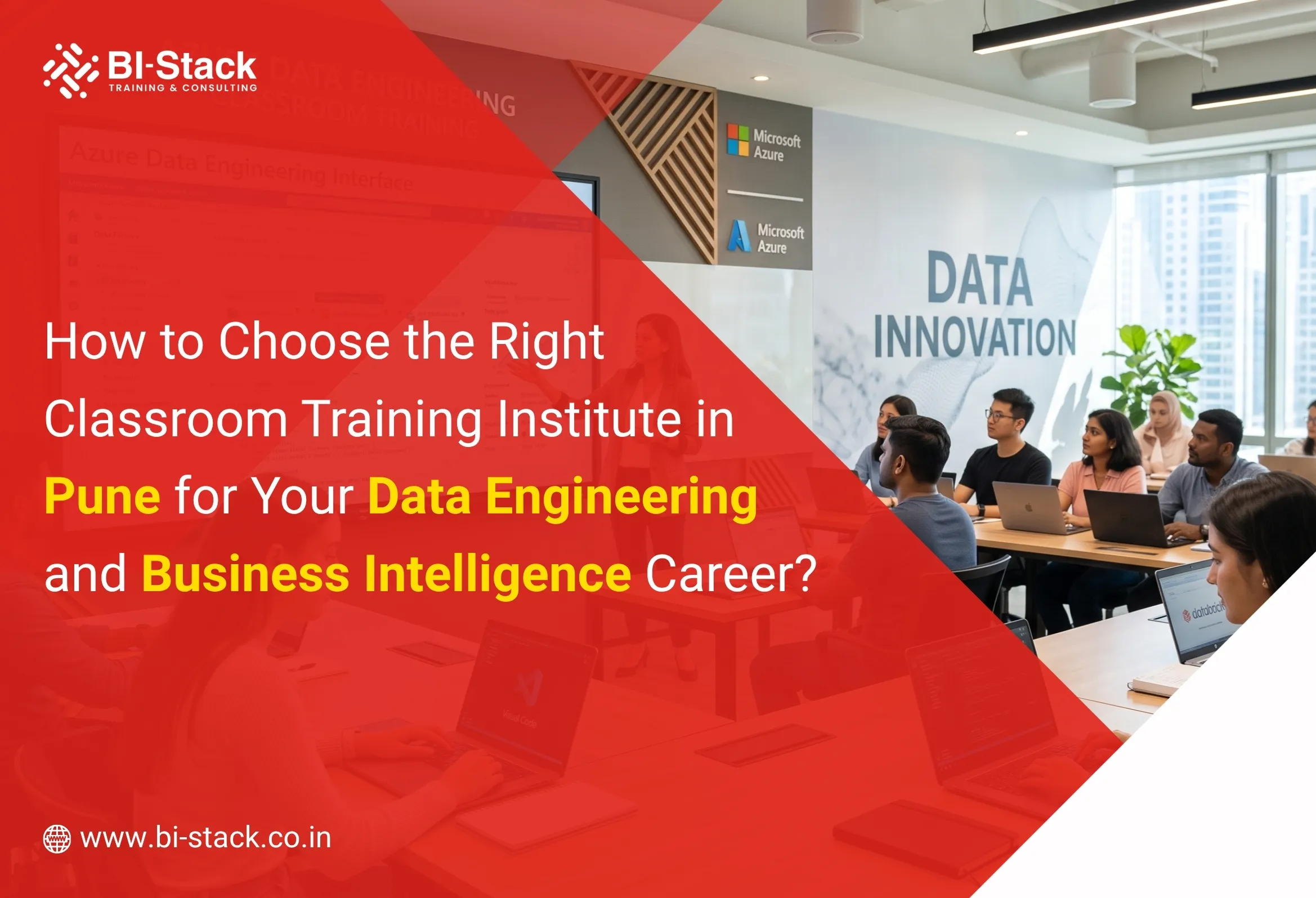
Choosing the right Data Engineering or Business Intelligence training institute in Pune can have a significant impact on your career. Pune has a large IT ecosystem, with technology hubs such as Wakad, Pimple Saudagar, Hinjawadi, PCMC and Kharadi, and there are many training institutes offering courses in Data Engineering, Azure, Databricks, Power BI and related technologies.
However, choosing an institute should not be based only on course fees, advertisements or the number of technologies listed in a brochure.
The more important question is:
Will the training help me develop the practical skills required to work as a Data Engineer or Business Intelligence professional?
This guide explains the key factors you should consider when selecting a classroom training institute in Pune and why BI Stack – Pune focuses on practical, project-oriented training for aspiring and experienced IT professionals.
Why Classroom Training Can Be Valuable for Data Engineering and BI
Data Engineering and Business Intelligence involve more than learning individual tools.
A Data Engineer may need to understand:
- SQL and data modelling
- ETL and ELT processes
- Data integration
- Azure Data Factory
- Azure Databricks
- PySpark
- Azure Synapse Analytics
- Data lakes and data warehouses
- Data pipelines
- Data quality and monitoring
- Git and deployment concepts
Similarly, a Business Intelligence professional may work with:
- SQL
- Data modelling
- Power BI
- DAX
- Power Query
- Data visualization
- Power BI Service
- Dashboards and reports
- Business requirements
- Performance optimization
Because these technologies are interconnected, classroom learning can provide an advantage when you can directly interact with an experienced trainer, ask questions and work through problems in real time.
The objective should not simply be to complete a syllabus.
The objective should be to understand how these technologies are used together in real-world projects.
1. Look for Real-World, Project-Based Training
One of the most important questions to ask an institute is:
“Will I work on a real project during the course?”
A good Data Engineering or BI course should go beyond demonstrations.
For example, a Data Engineering project could involve a complete flow such as:
Source Systems → Data Ingestion → Data Lake → Transformation → Data Warehouse → Power BI
Students should understand why each component is used and how the different technologies interact.
For example:
Azure Data Factory can be used for data ingestion and orchestration.
Azure Databricks and PySpark can be used for large-scale data transformation.
Azure Synapse Analytics can be used for analytical workloads.
Power BI can be used to build business reports and dashboards.
This project-oriented approach helps students understand the architecture instead of learning each tool in isolation.
BI Stack’s training approach emphasizes interactive and practical learning, live projects and certification-oriented training.
2. Evaluate the Trainer’s Industry Experience
The trainer can be more important than the training institute’s marketing material.
Before joining a course, ask:
- Does the trainer have real industry experience?
- Has the trainer worked on production projects?
- Can the trainer explain architecture decisions?
- Can the trainer explain why one technology should be used instead of another?
- Can the trainer answer scenario-based questions?
- Can the trainer explain how projects are deployed and maintained?
For experienced IT professionals, this becomes particularly important.
A trainer who has only prepared course material may be able to explain the syntax of a technology.
An experienced practitioner can explain:
“This is how you would actually implement it in a project.”
That difference can be extremely valuable when preparing for interviews and real-world work.
3. Check Whether the Curriculum Matches Current Industry Requirements
Technology changes quickly.
A Data Engineering curriculum should not focus only on basic SQL and traditional ETL tools.
Depending on your career objective, you should look for technologies such as:
Data Engineering
- SQL
- Python
- Azure Data Factory
- Azure Databricks
- PySpark
- Azure Synapse Analytics
- Data Lake concepts
- ETL/ELT
- Data modelling
- Data pipelines
- Git
- CI/CD concepts
- Data governance fundamentals
Business Intelligence
- SQL
- Power BI
- Power Query
- DAX
- Data modelling
- Star schema
- Power BI Service
- Dashboard development
- Performance optimization
- Business requirements analysis
The exact curriculum should depend on whether you are a fresher, an experienced developer looking to switch careers, or an existing Data/BI professional looking to upgrade your skills.
4. Understand the Difference Between Learning a Tool and Learning a Career Skill
This is an important distinction.
Suppose you learn Azure Data Factory.
Knowing how to create a pipeline is one skill.
Understanding when to use Data Factory, how to design a scalable pipeline, how to handle failures, how to parameterize pipelines and how to integrate it with Databricks and other services is a much broader professional skill.
Similarly, learning Power BI is not just about creating charts.
A professional BI developer should understand:
Business requirement → Data source → Data modelling → Transformation → DAX → Visualization → Performance → Deployment
Therefore, when comparing institutes, look for training that teaches the complete development lifecycle, not just individual features.
5. Choose a Convenient Classroom Location
Location matters more than many students initially realize.
Data Engineering and BI courses require regular practice. If travelling to the institute takes two hours each way, maintaining consistent attendance can become difficult.
For professionals working in Pune’s IT ecosystem, locations such as Wakad, Pimple Saudagar, Hinjawadi, PCMC and Kharadi can be convenient depending on where they live and work.
BI Stack provides training services across the Wakad, Pimple Saudagar, PCMC and Kharadi regions of Pune, with classrooms positioned around major IT and professional hubs.
The objective is to make classroom-based learning accessible to students and working professionals from different parts of Pune.
6. Consider the IT Ecosystem Around the Training Location
A training institute located close to major IT and commercial areas can be convenient for working professionals.
Pune has several important technology and business clusters.
Wakad and PCMC
Wakad and the wider PCMC region provide convenient access for professionals living around:
- Wakad
- Hinjawadi
- Tathawade
- Pimple Saudagar
- Ravet
- Pimpri-Chinchwad
Kharadi
Kharadi is another major technology and business destination in Pune and can be convenient for professionals working or living around:
- Kharadi
- Viman Nagar
- Hadapsar
- Magarpatta
- Wagholi
- Nagar Road
For someone working full-time, choosing a classroom close to home or the workplace can make it easier to attend consistently.
7. Ask About the Learning Format
Before enrolling, understand exactly how the classes are conducted.
Ask whether the institute provides:
- Live instructor-led sessions
- Hands-on lab exercises
- Project work
- Doubt-clearing sessions
- Interview preparation
- Weekend batches
- Weekday batches
- Classroom training
- Online training
- Access to learning material
- Practice assignments
For working professionals, weekend and flexible schedules can be particularly useful.
8. Don’t Select an Institute Based Only on Course Fees
Price is important, but it should not be the only selection criterion.
A cheaper course may not necessarily provide better value.
Instead, compare:
Course fee + trainer experience + practical sessions + project exposure + curriculum + learning support + classroom experience
For example, if two institutes have similar fees but one provides significantly more practical project work and trainer interaction, the second option may offer better career value.
Your objective should be:
Maximum practical learning per rupee spent.
9. Check Student Reviews Carefully
Google reviews and testimonials can help, but don’t look only at the overall star rating.
Read what students actually mention.
Look for comments about:
- Trainer quality
- Practical sessions
- Project experience
- Classroom environment
- Doubt resolution
- Course content
- Support after training
- Interview preparation
Also look for reviews from students who completed the specific course you are interested in.
For example, if you want Azure Data Engineering training, reviews mentioning Azure Data Factory, Databricks, Synapse or Data Engineering are more relevant than generic reviews.
BI Stack’s website includes student feedback covering Azure Data Factory, BI development, Azure Data Engineering and Power BI.
10. Ask for a Demo Class Before Enrolling
A demo class is one of the easiest ways to evaluate an institute.
During the demo, pay attention to:
Does the trainer explain concepts clearly?
Does the trainer explain the “why” behind the technology?
Does the trainer use practical examples?
Can the trainer answer technical questions?
Is the teaching suitable for your current skill level?
A good demo class should help you determine whether the trainer’s teaching style matches your learning requirements.
Why Choose BI Stack for Data Engineering and BI Training in Pune?
BI Stack – Pune focuses on practical training in Data Engineering and Business Intelligence.
The institute offers training across technologies including:
- Azure Data Engineering
- Azure Data Factory
- Azure Databricks
- Azure Synapse Analytics
- PySpark
- Microsoft Power BI
- SQL
- Big Data and related technologies
The BI Stack website states that its courses are designed for both freshers beginning their Data Engineering or BI careers and experienced professionals looking to switch or upgrade their skills.
The training approach emphasizes:
Practical Learning
The focus is on understanding how technologies are used in real-world scenarios rather than simply completing a theoretical syllabus.
Live Projects
Projects help students connect individual technologies and understand complete data workflows.
Industry-Oriented Curriculum
The objective is to teach skills that are relevant to modern Data Engineering and Business Intelligence roles.
Experienced Trainers
Learning from professionals with practical industry exposure can help students understand project scenarios, architecture decisions and interview expectations.
Classroom Training in Pune
BI Stack provides classroom-oriented learning options for students and professionals across important Pune IT regions.
BI Stack Training Locations and Service Areas
BI Stack serves students and working professionals across:
Wakad | Pimple Saudagar | PCMC | Kharadi
The institute’s classrooms are positioned around Pune’s IT and professional districts, making them accessible for students who prefer face-to-face instructor-led training.
BI Stack Wakad Classroom
For directions to the Wakad classroom:
Google Maps – BI Stack Wakad Classroom
BI Stack Kharadi Classroom
For directions to the Kharadi classroom:
Google Maps – BI Stack Kharadi Classroom
Which Data Engineering or BI Course Should You Choose?
The right course depends on your existing experience and career objective.
If you are a fresher
Start with:
SQL → Python → Data Engineering fundamentals → Azure → Data Factory → Databricks → PySpark → Data Warehouse → Power BI
If you are an ETL Developer
You can consider:
SQL → Azure Data Factory → Databricks → PySpark → Synapse → Cloud Data Engineering
If you are an existing BI Developer
Consider:
SQL → Advanced Data Modelling → Power BI → DAX → Power BI Service → Performance Optimization → Azure Data Engineering fundamentals
If you are an experienced IT professional looking to switch careers
A structured Data Engineering or BI program combined with hands-on projects can provide a more practical transition path than learning technologies independently.
Questions to Ask Before Joining a Data Engineering Training Institute in Pune
Before paying your course fee, ask these questions:
- Who will teach the course?
- How much industry experience does the trainer have?
- Is the training classroom-based or online?
- How many practical sessions are included?
- Will I work on a complete project?
- Is the project based on a realistic business scenario?
- What technologies are included?
- Is interview preparation included?
- Are doubt-clearing sessions available?
- Can I attend a demo class before enrolling?
- What are the batch timings?
- Where is the classroom located?
- Is support available after the course?
These questions can help you compare training institutes objectively instead of choosing based only on advertising or price.
Frequently Asked Questions
Which is the best Data Engineering training institute in Pune?
There is no single institute that is best for every student. The right choice depends on the trainer, curriculum, practical project exposure, classroom location, schedule and your career objective. Students should attend a demo class and compare these factors before enrolling.
Where can I find Data Engineering classroom training in Pune?
Data Engineering classroom training is available across several Pune IT regions, including Wakad, Pimple Saudagar, PCMC and Kharadi. BI Stack provides training services across these regions.
Is classroom training better than online training for Data Engineering?
Classroom training can be particularly useful for learners who prefer direct interaction with trainers, immediate doubt resolution and structured practical sessions. Online training can provide greater flexibility. The better option depends on the student’s learning style and schedule.
Is Azure Databricks useful for a Data Engineer?
Yes. Azure Databricks and Apache Spark-based technologies are widely used for data transformation, distributed data processing and modern data engineering workloads. However, Databricks should be learned as part of a broader Data Engineering architecture rather than as an isolated tool.
Is Power BI a good career option?
Power BI can be a strong skill for professionals interested in Business Intelligence, reporting, analytics and data visualization. However, professional Power BI development requires more than creating dashboards. SQL, data modelling, Power Query, DAX and business understanding are important skills.
What should I learn to become a Data Engineer in Pune?
A typical learning path can include:
SQL → Python → Data Engineering fundamentals → Azure Data Factory → Databricks → PySpark → Data Warehousing → Cloud → Projects
The exact path should be adjusted according to your existing experience.
What should I check before joining a Power BI training institute in Pune?
Check the trainer’s experience, Power BI curriculum, SQL coverage, data modelling, DAX, Power Query, Power BI Service, practical projects, classroom format, reviews and interview preparation.
Does BI Stack provide classroom training in Pune?
Yes. BI Stack provides classroom-oriented training and serves learners across Pune regions including Wakad, Pimple Saudagar, PCMC and Kharadi. The institute offers courses in areas such as Azure Data Engineering, Azure Data Factory, Azure Databricks, Azure Synapse Analytics, PySpark and Power BI.
Final Thoughts
Choosing a Data Engineering or Business Intelligence training institute in Pune is an important career decision.
Don’t choose an institute simply because it promises to teach many technologies.
Instead, look for a combination of:
Experienced Trainers + Practical Learning + Real-World Projects + Relevant Curriculum + Convenient Location + Interview Preparation
If your goal is to build practical skills for a career in Data Engineering, Azure, Databricks, PySpark or Power BI, BI Stack – Pune provides classroom and practical training options across the Wakad, Pimple Saudagar, PCMC and Kharadi regions.
To explore courses, training options and upcoming batches:
BI Stack – Pune | Practical Data Engineering & Business Intelligence Training